Why Old Philadelphia Garage Doors Struggle With Cold Winters
Most Philadelphia homes went up between 1938 and 1994, well before modern insulation rules, and cold winters find every gap in an old garage door fast.
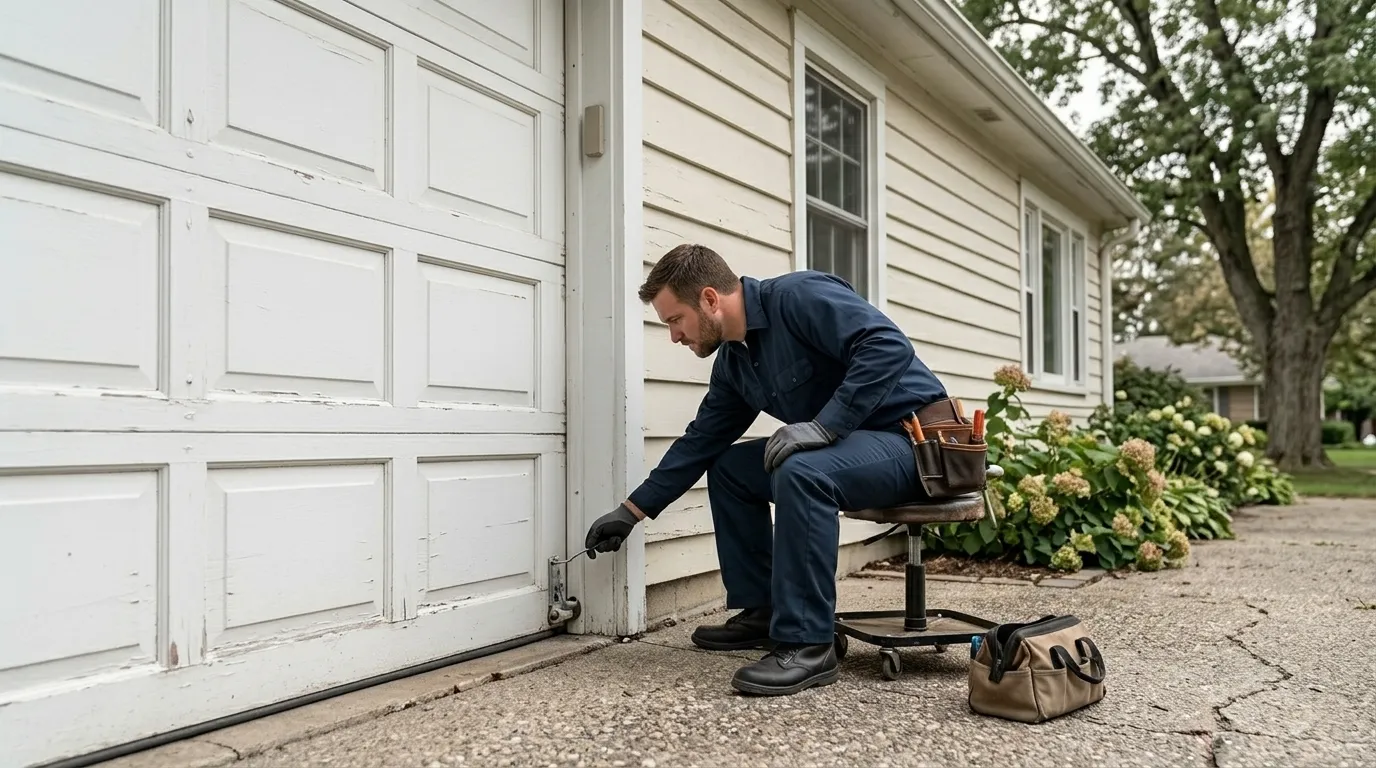
Philadelphia sits in a climate band we track as cold and severe, which means real freeze-thaw cycles every winter, not just a few cold snaps. That matters more here than in a lot of places because the housing stock is old. Homes in this area were built mostly between 1938 and 1994, with a median build year of 1957 - doors on houses built before insulation rules were common. A door from that era was hung to keep out weather, not to hold an R-value, and the steel, the seals, and the track alignment reflect that.
Cold does two things to an old door. It shrinks metal, which opens gaps at the bottom seal and the panel joints that were already loose from age. And it stiffens grease and thickens oil in old bearings and rollers, so a door that rolled fine in September starts binding or groaning in January. On a torsion spring older than the code updates that followed it, that added resistance is exactly the kind of stress that turns a slow year of wear into a sudden snap. None of this is dramatic. It's just what happens when 1957-era hardware meets a real Philadelphia winter, one more time than it can take.
What Is Going On
Across the 95 named areas in this part of the region, the housing stock is overwhelmingly pre-1960 - this isn't a pocket of old homes, it's most of them, from the rowhouses closer in to the larger lots further out toward places. That means original garage doors, or first-generation replacements from decades ago, are still common rather than rare.
With 160,961 owner-occupied houses among 409,216 households in this service area, there's a large base of homeowners dealing with the same basic problem: a door engineered to a much older, thinner standard, now expected to perform through the kind of cold cycling that wasn't really part of the original design brief. The steel gauge is often lighter, the insulation is often none at all, and the torsion spring cycle count has usually been used up by a door this old well before anyone thinks to check it. Add a hard winter on top of that and small issues - a rough spot in the track, a slightly bent panel, a spring near the end of its life - stop being small. They start showing up as the door that won't close all the way, or the loud bang that means a spring let go.
What Most People Get Wrong
The most common mistake is treating a door problem as a weather problem. An owner notices the door is harder to lift in December and assumes it's just cold, that it'll loosen up again in spring. Sometimes it does. More often, the cold didn't cause the problem - it just found the failure that was already building in a spring or a roller that's outlasted its expected life by years, which is easy to do on housing stock with a median build year of 1957.
The other mistake, and it's an understandable one given a median household income of $109,706 in this area - enough for most owners to afford a proper fix rather than a patch - is spending money on the wrong repair. Weatherstripping and a new bottom seal help with drafts, but they don't address a spring that's fatigued or a track that's out of alignment from decades of settling. We'll be honest: if the door itself is original to a 1957-median-era house, a seal kit is a band-aid, not a fix, and we'd rather tell you that up front than sell you the kit and see you back in a month.
Leaving It Alone
A door that's been struggling all winter and gets ignored usually doesn't fail gently. Torsion springs on older doors, the kind common across this pre-1960-heavy housing stock, don't wear down gradually and give a warning - they hold, then they don't. In a cold severe climate, the added stress of shrunk metal and stiff hardware pushes a spring that's already near the end of its cycle life over the edge, often on the coldest morning of the year, which is also the worst time to have a door stuck shut or stuck open.
We won't pretend every old door needs full replacement. Plenty of doors from this era are solid steel and worth keeping, with the spring, rollers, and cables replaced instead. But a door that's warped, that's lost its insulation value entirely, or that's had two or three spring failures already is a door where more repair money is going after a fixed cost that replacement would solve for good. Waiting past that point usually means an emergency call instead of a scheduled one, and a stuck door in January is a worse problem than a scheduled repair in October.
How it works
From “it’s stuck” to “it’s fixed”
01
Tell us what’s wrong
Describe the symptom - won’t open, loud bang, opener runs but the door won’t move.
02
On-site diagnosis
A technician tests the door under power and by hand and finds what actually failed.
03
Clear, up-front plan
You get the fix that’s needed and what drives the cost - before any work starts.
04
Repaired & tested
The repair is done, the door is set true and tested, and the work area left clean.
Serving Philadelphia, PA - tell us what your door’s doing and we’ll take it from there.
Why does my garage door only act up in the winter?
Cold shrinks metal and stiffens old grease in springs and rollers, which adds resistance to a door that's already worn. If your house dates to the common 1938-1994 build range here, the door is often original or an early replacement, so a winter slowdown is usually an existing weakness the cold exposed, not something the cold created on its own.
Is my garage door too old to just repair the seals?
If the door itself dates to the same era as most homes here, built before modern insulation rules, a new bottom seal helps with drafts but won't fix a fatigued spring or a misaligned track. We'd rather tell you that plainly than sell a seal kit and have the same door fail on you again next winter.
How do I know if my spring is close to failing?
There's usually no clean warning - torsion springs on older doors tend to hold right up until they don't, especially after a hard cold cycle. If the door feels heavier to lift than it used to, or you hear new noise from the spring area, that's worth a look before winter, not after a bang.
Ready to get your garage door sorted?
Tell us what it’s doing and where you are in Philadelphia - we’ll take it from there.